When to Hire a Fractional CMO, and When to Hire Someone Else
Hire a fractional CMO when marketing has broken, nobody on your team can fix it, and you can't yet carry a full-time CMO. The checks, and who to hire instead.

Hire a fractional CMO when something in marketing has broken, growth has stalled because of it, nobody on your team has the experience to fix it, and you can't yet carry a full-time chief marketing officer.
At B2B businesses between $1M and $15M, I hear it on first calls. One CEO: "We missed revenue for the 2nd quarter in a row." Another: "What we're doing isn't working." In my experience, what's behind it: marketing is busy, and nobody can tie what it spends to pipeline your head of sales accepts. The team works hard, but there's no senior marketing leader above them who has run marketing before. And the obvious fix, a full-time CMO, costs $26,000 to $34,000 a month fully loaded at a company under $15M, plus equity, after a search of three to six months.
A stall isn't always a marketing problem, though. If what's broken is how your team sells, or the handoff between marketing and sales, a fractional CMO is the wrong hire. Below: how to tell which it is, what to check this week, and who to hire instead.
I've run marketing and sales in every revenue role I've held since 1999, and I've had a quota on me for 27 years and never missed, most of it in leadership. I've been a fractional CMO since 2020. Because I've run both sides, this guide shows you when the right hire isn't a CMO, and when it isn't me.
Part of the fractional CMO guide.
When Should You Hire a Fractional CMO?
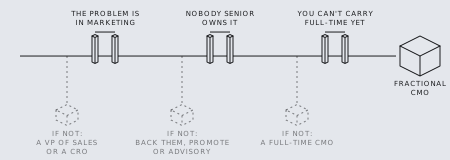
Hire one when all three of these are true:
- Growth has stalled, and the reason is in marketing. Something in the marketing strategy has stopped working: who you're for, what you say, or the leads marketing hands to sales. The section on what's broken shows you how to tell.
- Nobody senior owns marketing. You run it between everything else, or a capable marketing team runs it with no senior marketing leadership above them.
- You can't yet carry a full-time CMO, or there's no working marketing function to hand one. In my experience, the person you hire to run a function spends their first year building one.
If any one of the three is false, a fractional CMO is the wrong hire, and the table further down names the right one.
Then look for one green light: customers who already love what you sell. "We thought we knew what we were doing, our customers love us, but we can't seem to get enough of them." That's how a lot of the CEOs who call me start. Marketing has something to work with.
Signs You Need a Fractional CMO
Six checks, each a conversation or a spreadsheet you can do this week. Each one tells you whether the gap is one a fractional CMO fills.
Line Up Last Quarter's Spend Against Accepted Leads
Take last quarter's marketing spend, line by line, and beside each line write a lead it produced that your head of sales accepted. I read blank lines as money nobody is answering for. One CEO put it to me this way: "We hired an agency and we're not quite sure what they did for it." If most lines have a lead beside them, I'd read that as money working, and look for the problem somewhere else.
Ask Sales Which Marketing Leads They'd Call Back
Ask your head of sales which of last month's marketing leads they'd call back today, and why not the rest.
If nobody ever agreed what a lead is, that's a marketing leader's first job: one definition, agreed with sales. If they agreed and have argued about it ever since, the problem is the handoff between the two teams, and that's a CRO's job. If sales would call most of them back, marketing's half is working.
Ask Your Marketing Team What the Work Is For
Ask each person on your marketing team what this quarter's work is for, and listen for a number sales would recognize.
A list of marketing channels, or three different answers, tells me the work is being picked one channel at a time, with no number behind it. From what I've seen, that's why marketing efforts feel random from the outside. If they all name pipeline, I'd read that as someone already leading them.
Count the Marketing Decisions Waiting on You
List everything in marketing that's waiting on a decision from you right now. One CEO put it to me plainly: "I know we need marketing and sales, and that's just not me."
A long list means marketing's only senior owner is you, part-time, between everything else you run. A short list means someone else is deciding, and the next check tells you whether they're ready to.
Check What Your Marketing Manager Decides Alone
If you hired or promoted someone to grow into the role, compare what they decided on their own this quarter with what they brought to you.
If most of it came to you, they aren't leading yet. I've found the person in that spot usually has it in them; they just don't have the playbook. A fractional CMO leads them through it while they grow. If they decided most of it themselves, back them.
Before You Hire a CMO, Check What They'd Walk Into
Before an executive search firm starts looking, ask whether you could hand a new chief marketing officer three things on day one: one definition of a lead sales agrees with, a marketing budget tied to the pipeline it creates, and a team that knows what the work is for.
If you can, and you can carry the cost, hire full-time. If you can't, build those first, so the CMO you hire starts by running marketing.
What's Broken: Marketing, Sales, or the Handoff Between Them?
A missed quarter tells you something is broken. It doesn't tell you where, and where decides whether you hire a CMO or someone else. Four things have to work for marketing and sales to produce revenue, and I've worked in this order in every revenue role I've held since 1999. Each has a check and an owner:
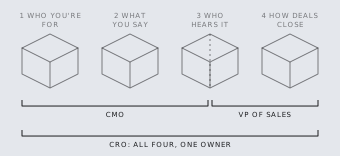
If marketing and sales keep blaming each other over the handoff, both teams need to report to one person. That's a CRO.
The order matters. When more than one of these is broken, fix the earliest first. Paying for a later fix while an earlier one is still broken is how the money leaks, and you can't see where. That order is the RevenueEngine™: four fixes, always in the same order.
Questions to Ask Yourself Before You Hire a CMO
- What's broken? A good answer names one of the four rows above, and it's row 1, 2 or marketing's half of row 3.
- Who owns marketing today? A good answer names a person who decides. If it's "me, when I get to it" or "the team, between them," that's the gap in marketing leadership you're hiring for.
- Which number should marketing answer for? A good answer is the pipeline your head of sales accepts. If yours is leads or traffic, fix that first.
- Who would report to the person you hire? A good answer is your marketing department and the agencies marketing pays. If nobody would, you're buying advice. That can be the right buy; just don't pay for a leader and get an advisor.
- Could you carry a full-time chief marketing officer, and would they have a working function to run? A good answer is a plain yes or no to each. Yes to both, and you want someone in the building every day: hire full-time. No to either: a fractional CMO, if the other conditions hold.
- Do your customers love what you sell? A good answer sounds like "they love us, and we can't get enough of them." If you can't say that yet, you may still be finding out whether the market wants what you built.
When Not to Hire a Fractional CMO
If one of the three conditions is false, a fractional CMO is the wrong fix for your money. Here's who I'd hire instead.
Fractional CMO vs. Full-Time CMO vs. Interim CMO
One question decides it: does marketing work yet?
If it does, hire a full-time chief marketing officer. A full-time executive is worth that money once marketing works and needs running every day.
If it does and your marketing leader just left, an interim CMO is a stand-in who covers the gap while you search for a permanent executive.
If it doesn't, a fractional chief marketing officer builds the marketing function that permanent executive will walk into. They sit in the same role a full-time CMO would, over your marketing team and reporting to you, on a monthly retainer instead of a salary. When to make each choice: Fractional vs. Full-Time →
What a Fractional CMO Should Do Once You Hire One
Your in-house marketing team reports to the fractional CMO, along with the agencies and contractors marketing pays, and the fractional CMO reports to you. Your head of sales keeps reporting to you, as a peer. The fractional CMO owns the marketing strategy, the marketing budget, demand generation and the agencies it pays, and hires and develops the team. The marketing decisions on your list become theirs to make.
They answer for one key performance indicator: the pipeline marketing creates, counted where your head of sales accepts it. Form fills and traffic don't count, because whoever you hire will chase the number you give them. Every month should open with deliverables and dates, written down, that you hold them to. By day 30, ask to see the one definition of a lead your head of sales has agreed to. By day 90, ask to see pipeline on a dashboard your head of sales agrees with.
A fractional engagement ends one of two ways: someone on your team grows into the role, or you hire a full-time CMO into marketing that already works. If it's a full-time hire, your fractional CMO should help write the job description and sit in on the interviews.
That's how I run mine, at $5,000 to $7,000 a month, remote. Fractional CMO →
For fractional CMO cost across the market, and how to read a monthly retainer quote: How much does a fractional CMO cost? →
When you're ready to talk to fractional CMO candidates, the guide has the questions to ask them: How to hire a fractional CMO →
When to Hire a Fractional CMO: Questions, Answered
How Many Hours Does a Fractional CMO Work?
Most guides say 5 to 20 hours a week, and that's how many are sold. Hours are the wrong measure. Ask what's on the list each month and when each item is due, and hold your fractional CMO to the dates. I don't sell hours or count them.
Is a Fractional CMO Worth It?
Judge it on the pipeline your head of sales accepts. Since 2020, averaged across my fractional clients: two to three times the leads that sales accepted, and two to six times the pipeline. That's my record, not a forecast of yours. If a month misses, ask for the reason and what changes next month.
Should You Hire a Fractional CMO Before You Raise a Round?
Only if the three conditions are already true. A round gives marketing money to spend. It doesn't decide what to spend it on.
Can a Fractional CMO Fix a Sales Problem?
No. Your head of sales keeps the team, the process and the forecast, and a fractional CMO can't fix a sales problem from one side of the line. If deals stall after sales accepts a lead, hire a VP of sales. If the fight is over the handoff, hire a CRO.
Is a Fractional CMO the Same as a Marketing Director?
No. In my experience, a marketing director runs the campaigns and the team week to week. A fractional chief marketing officer sits above them, sets the marketing strategy, and answers to you for the number.
Is a Part-Time CMO or an Outsourced CMO Different?
No. Part-time CMO and outsourced CMO are other names for the same role. Whatever it's called, check two things: your marketing team reports to them, and they answer for accepted pipeline.
Find What's Broken, Then Hire for It
This week, ask three people who your best customer is and why they pick you. Their answers will tell you more about who to hire than your revenue number will. If you get three different answers, I'd start with positioning, before hiring anyone to market it.
- 2020Fractional CMO & CROAveraged across clients2–6× · pipeline
- 2018Chief Revenue Officer20-year-old company+300% · 2 years
- 2015VP of Sales & MarketingStartup+107% · 2 years
- 2014EVP Sales & MarketingStartup → Unicorn Status+300% · 1 year
- 2006VP Channel & Business DevelopmentStartup → Unicorn Status+600% · 8 years
- 1999Global Sales DirectorPublic Software Company+400% · 7 years
Free: a week of analysis, a one-hour report-out, and an action plan you keep.