Fractional CMO: What One Does, What It Costs, and When a Company Your Size Needs One
A fractional CMO runs your marketing month to month instead of full-time. What one does, what it costs, when you need one, and two questions to ask first.

A fractional CMO is a chief marketing officer you engage month to month instead of hiring full-time. Your marketing team reports to them and they report to you, so marketing gets one owner who isn't you. A good one answers to you for one number: the pipeline marketing creates.
If "fractional" makes you wince, I get it. If you've read the thread calling it a stupid term, or the post calling it, in most cases, a terrible idea, the critics are right about three things, and I'll show you which.
You may also be where the CEOs who call me usually are. One put it this way: "We worked harder this year, and made less than last year."
Most of them have already hired one marketing leader who didn't work out. In my experience, two questions would have caught it: who would report to them, and which number they'd answer for. This guide is built around both.
I've been a fractional CMO since 2020, and I've had a quota on me for 27 years and never missed, most of it in leadership. So I grade marketing performance where sales grades it: on the pipeline your head of sales accepts. Here's how my fractional CMO services run: Fractional CMO.
What Is a Fractional CMO?
A fractional chief marketing officer is a senior marketing executive who provides your marketing leadership on a monthly engagement instead of a salary. Most guides describe the role by its hours: 5 to 20 a week. That's how many are sold, and it's the wrong way to buy one.
I define the role by where it sits, which is exactly where a full-time chief marketing officer would: over your marketing team, reporting to you, beside your head of sales.
Your marketing team reports to the fractional CMO, who also directs the agency partners and contractors marketing pays. Your head of sales keeps reporting to you. And the role answers for the pipeline marketing creates, counted where your head of sales accepts it.
If those reporting lines aren't true, you haven't hired a fractional CMO. You've hired a marketing consultant with a bigger title.

Fractional vs. Part-Time vs. Interim vs. Outsourced CMO
Part-time, outsourced and virtual CMO are other names for the fractional CMO seat. Interim CMO is a different job.
- Part-time CMO: the seat named for the hours it's priced on.
- Outsourced CMO: the seat named for where the person comes from: outside the company.
- Virtual CMO: the seat named for how the person works: remotely.
- Interim CMO: a stand-in who covers the gap while you search for a permanent executive. A fractional CMO builds the marketing function that permanent executive hire will walk into.
- Fractional CMO: the seat named for its share of a senior marketing leader. Judge it by what reports to it and which number it answers for.
What Does a Fractional CMO Do?
A fractional CMO turns your growth strategy into a marketing strategy and runs the marketing team that carries it out. In my experience, at a company your size marketing's been run by the CEO between everything else, or by a busy team with nobody senior telling them what the work is for.
What a Fractional CMO Owns
Six things, each tied to your business goals through one number: the pipeline marketing creates.
- Who you're for and why you win. Your market positioning: the buyer, the alternative they'd otherwise choose, and the reason they pick you. A good one works it out from the deals you've won, lost and stalled, not from a brand positioning workshop. In my experience, a position written without the deals read doesn't get used. (Market positioning has its own guide.)
- What you say. Your value proposition in your buyers' words, on your website, in your pitch, in the deck your reps open with and in the first line of every campaign.
- Who hears it. Demand generation and digital marketing: the channels, campaigns and outbound that reach buyers who don't know you yet, up to the moment a lead goes to sales.
- The marketing budget. Every dollar of it, every agency and contractor it pays, and what stops getting paid for.
- What marketing created. Marketing performance, measured in your CRM and reported to you and your board.
- The marketing team. Team leadership: hiring, developing, and the hard conversation when one is needed.
Order matters more than effort. The most expensive mistake I see is paying for a later fix while an earlier one is still broken, like more performance marketing spend on top of a position nobody has settled. The money leaks, and you can't see where. Ask any fractional CMO candidate what they'd fix first, and why that first.
What a Fractional CMO Leaves to Others
A fractional CMO runs marketing and stops at the edges of it.
- Your sales team. Your head of sales keeps the team, the process and the forecast. If the problem sits between marketing and sales, see the fractional CRO, below.
- Making the work. A fractional CMO directs design, video and development. If you need someone to make them, you need execution resources: a production team or an agency.
Whatever they build should live in your CRM and your shared drive, so the company still owns it the day they leave.
How Much Does a Fractional CMO Cost?
In this market, other fractional CMOs charge $7,000 to $12,000 a month for a standard engagement and $15,000 to $25,000 for an embedded one, sold by the hours a week: ten to twenty at the standard rate.
Watch the bonus. When the market's deals carry one, it's often tied to numbers marketing controls alone: a form filled in, an ad clicked, a post liked. Every one of those can rise in a quarter in which sales books nothing.
A full-time CMO at a company under $15M costs $310,000 to $410,000 a year fully loaded, plus equity, and the search takes three to six months before anyone starts. In my experience, that's a lot of full-time executive pay to hand a function that doesn't work yet.
Mine is $5,000 to $7,000 a month, remote, month to month, with your marketing team reporting to me. The top of my band is the bottom of theirs, and I don't price by the hour. You can stop after any month: no minimum term, no notice period, no equity, no bonus.
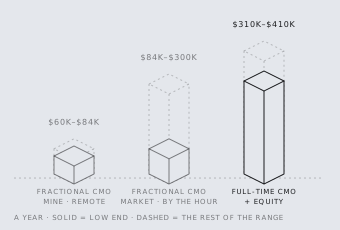
If you're already paying for digital marketing and an agency and nobody can tie the spend to pipeline, the question isn't whether you can afford a fractional CMO. It's how long you can afford nobody owning that spend.
Why "Fractional CMO" Has a Bad Name, and the Two Questions That Sort It Out
Critics of fractional CMOs are right about three things, and you should hold every candidate to them:
- Sold by the hour. Most fractional CMOs sold through networks are sold by the hours a week, so what you're buying is time. Time doesn't answer for anything.
- Staffed from a bench. Firms with a roster assign a consultant, and you don't choose who shows up. The person who sold you the engagement may not be the one who does the work.
- Graded on clicks. Marketing performance gets graded where it's easy to measure. In my experience, a marketer who's never had a quota rarely looks past the click.
So ask two questions before you hire a fractional CMO:
- Who would report to you? If the answer isn't your marketing team, you're buying advice.
- Which number would you answer for? If the answer is form fills or traffic, you're buying activity. The number worth paying for is the pipeline marketing creates, counted where your head of sales accepts it.
If you've already hired one who didn't work out, ask the same two questions about them. If the answers were "nobody" and "traffic," you know what went wrong, and it wasn't only them.
My answers are your marketing team and the pipeline your head of sales accepts. I'm one person, with no associates and no bench, so the one you talk to before you sign is the one who does the work. If the number slips, I tell you before you ask, with why and what I'm changing next month.
Since 2020, averaged across my fractional clients: two to three times the leads that sales accepted, and two to six times the pipeline. That's my record, not a forecast of yours. I know which leads get called. I've been the one calling them.
When Does a Company Need a Fractional CMO?
In my experience, a company between $1M and $15M needs a fractional CMO when one of these is true:
- Marketing spends money nobody can connect to pipeline. One CEO who called me put it plainly: "I know we're paying for marketing. I don't know how much, but I know we're spending a lot and not getting anything in return for it."
- The team works hard and nobody senior leads it. Smart, busy people with no experienced marketing leadership to tell them what the work is for.
- You promoted your marketing manager, and they haven't grown into it. It happens to good people. In my experience, they had it in them; they just didn't have the playbook.
- You're about to hire a full-time CMO into a marketing function that doesn't work yet. Fix it first, so they walk into a job instead of a rebuild.
When You Don't Need One
You don't need a fractional CMO when the problem sits where a CMO can't reach it.
- Marketing and sales are blaming each other. They're the two most disconnected groups in an organization. If the fight is over who owns the handoff, the problem is the seam between them, and a CMO only stands on one side of it. That's a fractional CRO, with both teams reporting to one person: Fractional CRO
- You need hands. If you already have a marketing strategy and just want it carried out, hire production.
- Your customers don't love you yet. If you're still finding out whether the market wants what you built, more marketing sells the wrong thing faster.
- Marketing's already producing pipeline your head of sales accepts. Keep doing what's working.
Should You Hire a Fractional CMO, a Full-Time CMO, an Agency or a Consultant?
An agency is one of the things a fractional CMO runs. It needs someone above it deciding the marketing strategy, and if nobody is, that's the gap. If the company can carry $310,000 or more a year plus equity, wants someone in the building every day and has marketing stable enough to hand over, hire full-time: Fractional vs. Full-Time
How to Hire a Fractional CMO
The first thing I ask about a fractional CMO candidate is who reported to them. Ask these before you sign, of anyone, me included:
- Who will report to you, and who won't?
- Which number is yours, and where is it counted?
- Have you ever had a quota?
- What will this cost me a year, and what would make it go up?
- What's on the list each month, and how do I hold you to it?
- Will you talk to our customers? The ones you won, the ones you lost, and the ones who went quiet.
- How does this end? A good answer names who runs marketing after they leave.
A fractional CMO candidate who answers all seven well has earned a reference check, so ask to speak to someone who reported to them. One who answers the first two with "it depends" is selling you time.
Who Should Run Your Marketing
These are the six ways I see marketing run at your size. Ask the same two questions of each.
You. It's yours already. The cost is your week, taken from everything else you run. Most CEOs who call me have tried this and stopped at the hard part.
Someone you promote or hire junior. A promotion already knows your customers, and either one gets a real path up. If one of your people has run marketing at another company, promote them and save the money.
A fractional CMO through a network. Networks of fractional marketing leaders sell you the engagement and assign a consultant from the roster, usually sold by the hours a week. Ask who reports to them and which number is theirs.
Advisory. $3,000 to $4,000 a month, remote, month to month. For a CEO whose team can do the fixing: I provide strategic direction, telling you what I'd fix and in what order, and your team does it. Nothing reports to me. Advisory
Done my way: Fractional CMO. $5,000 to $7,000 a month, remote, month to month, with no minimum term. Your marketing team reports to me and I report to you; your head of sales stays my peer. Each month opens with the deliverables and dates we agree, written down, and you hold me to them.
I fix revenue with the RevenueEngine™: four fixes, always in the same order (positioning, messaging, prospecting, sales). As your fractional CMO, I do the fixing on the first two, build the third up to the moment a lead goes to sales, and leave the fourth with your head of sales.
I've worked in this order in every revenue role since 1999, and revenue grew in every leadership role I've held, somewhere between 107% and 600%. That's my record, not a forecast of yours.
The trade: I'm one person, so there's no bench to add when you want more hands. And I'm remote. If you need someone in the building, I'm the wrong hire. Fractional CMO
A full-time CMO. A full-time executive in the building every day, once you've found one: three to six months to search and $310,000 to $410,000 a year fully loaded, plus equity.
Fractional CMO Questions, Answered
How Many Hours Does a Fractional CMO Work?
Most guides say 5 to 20 hours a week, and that's how many are priced. I'd ask what's on the list this month instead, and when each item is due. A good engagement opens each month with deliverables and dates, agreed and written down, so you manage deliverables rather than hours. I don't sell hours or count them.
How Do You Know a Fractional CMO Is Working?
I'd judge it on three things. In the first month: the list, the dates, and one definition of a lead agreed with your head of sales. By the third: the pipeline marketing creates, on a dashboard your head of sales agrees with. And every month: no surprises, because a miss is reported before you go looking for it.
Would a Fractional CMO Work With Your CFO?
A fractional CMO should be part of your executive leadership team and work with your CFO on the budget. They own the marketing budget, so I'd want your CFO to see what marketing spent and what it created every month, in the same numbers the board sees.
Why Do Companies Hire a Fractional Chief Marketing Officer?
In my experience, companies hire a fractional chief marketing officer when they need experienced marketing leadership before they can carry a full-time executive. The fractional CMO model sits in the same seat a full-time CMO would and takes on the same strategic leadership responsibilities. What changes is the commitment, month to month instead of salary and equity, and, with mine, that it's remote.
Should a Fractional CMO Run Your Digital Marketing?
A fractional CMO should direct your digital marketing, not produce it. They decide the channels, the budget and what each one has to create; your team or your agency builds the campaigns. I direct production; I don't manufacture it.
What's the Difference Between a Fractional CMO and a Marketing Director?
In my experience, a marketing director runs the campaigns and the team week to week. A fractional CMO sits above that: owns the marketing strategy and the budget, and answers to you for pipeline. If you have a marketing director, a fractional CMO directs and develops them.
How Long Does a Fractional CMO Engagement Last?
A fractional CMO engagement should last until someone can take marketing over: someone on your team ready to lead it, or a full-time CMO hired into marketing that works. Mine is month to month with no minimum term. If it's a full-time hire, I help write the job description and sit in on the interviews.
Can a Fractional CMO Work Remotely?
A fractional CMO can run marketing from inside your leadership team meetings, your CRM and your documents. Every engagement I run is remote, and recent ones have been across the US and in Europe.
What's the Difference Between a Fractional CMO and a Fractional CRO?
A fractional CMO sits over marketing, and your head of sales is a peer. A fractional CRO sits over both teams, so the head of marketing and the head of sales report to the CRO. It's the CMO role moved one level up, and it's the one to hire when the fight is over the handoff between the two teams.
Can a Fractional CMO Guarantee Business Growth?
No. I don't guarantee outcomes. Nobody honest does. What a good one can do is own marketing's number and tell you about a miss before you go looking for it.
Ask the Two Questions Before You Hire Anyone
Whoever you're about to hire to run marketing, ask who would report to them and which number they'd answer for. If the answers are your marketing team and the pipeline your head of sales accepts, you've found someone worth asking the other five.
If my answers are the ones you want, my fractional CMO services page has the rest: what's in scope, what isn't, and how the first ninety days run. And whoever you hire, the first thing they should check is who you're for and why you win: Market positioning.
- 2020Fractional CMO & CROAveraged across clients2–6× · pipeline
- 2018Chief Revenue Officer20-year-old company+300% · 2 years
- 2015VP of Sales & MarketingStartup+107% · 2 years
- 2014EVP Sales & MarketingStartup → Unicorn Status+300% · 1 year
- 2006VP Channel & Business DevelopmentStartup → Unicorn Status+600% · 8 years
- 1999Global Sales DirectorPublic Software Company+400% · 7 years
Free: a week of analysis, a one-hour report-out, and an action plan you keep.