Competitive Landscape: Find the Rival You Lose to Most (It's Usually Nothing)
How to build a competitive landscape from your deals: rank the alternatives buyers actually weigh, price doing nothing, and decide what reps compare you to.
Your competitive landscape is every option your buyer weighs, and at a company your size the one you lose to most usually isn't a company. It's the buyer who agreed with everything and did nothing. Here's how to find yours in your own deals, and put a price on it.
The calls I get after a competitor move usually start one of two ways: a competitor just landed funding, or a competitor just took the biggest client. I've run marketing and sales in every revenue role I've held since 1999. In that time, the competitor I've watched take the most deals wasn't on anyone's competitor slide. It was a buyer deciding the problem could wait another year.
What you're really up against is the second of the three decisions in market positioning, after who you're for and before why you win. In my experience, it's the one companies answer with a list of logos.
What Is a Competitive Landscape?
A competitive landscape is the set of alternatives your target customers weigh before they buy from you: direct competitors, indirect competitors, doing it themselves, and doing nothing.
Most guides map the companies in your market with a competitor analysis framework: a SWOT analysis, a comparison matrix, a strategic group analysis, or Porter's five forces. I'd call most of that industry analysis. It's more use to an investor than to you when you're deciding what your sales teams say on Tuesday.
I'd define the competitive landscape by one question: what would the buyers you want do if you didn't exist? Everything they'd name belongs on the map. Anything they wouldn't name doesn't, however big it is. A competitive landscape analysis, done that way, ranks those answers by how often they win and says why.
Competitive Landscape vs. Competitive Analysis vs. Competitor Analysis
- Competitor analysis studies one rival's strengths and weaknesses: their offer, their price, their pitch, their wins.
- Competitive analysis does that across several rivals; in my experience it ends in a feature comparison.
- The competitive landscape is the whole market landscape your buyer sees, including the options that aren't companies.
I'd build the landscape first and do competitor analysis only on the rivals that make the top of it.
Direct and Indirect Competitors, and the One That Isn't a Company
Direct competitors sell what you sell to your target market. Indirect competitors solve the same problem a different way: a consultant instead of software, a hire instead of a service.
Then there are the two alternatives no competitor slide shows: doing it by hand (the spreadsheet, the whiteboard, the intern) and doing nothing. I count them as one group, because both mean the buyer kept what they had, and at your size that group usually sits at the top of the list. The spreadsheet stays, the intern keeps at it, and the problem gets lived with for another year, because living with it looks cheaper than fixing it.
Why Competitive Landscape Analyses Miss the Competitor You Lose to Most
In my experience, they miss him four ways.
They're built from competitors' websites. A website tells you a rival's value proposition. Your lost deals tell you what buyers chose.
They list everyone with a logo. If your buyers wouldn't name a rival, it has no place on your map, however big its logo.
They leave out doing nothing. A comparison matrix needs a column for every alternative, and "waited a year" doesn't have a feature list. So it's left off.
They never put a price on the alternative. The map shows who's out there. It doesn't show what each alternative costs the buyer to keep, which is the number your sales teams should lead with.
A competitive analysis built from websites can't show you the buyer who read everything you sent, agreed with all of it, and did nothing. He's the competitor you lose to most.
How to Do a Competitive Landscape Analysis From Your Deals
You don't need competitive intelligence software or a research firm for this. You need two years of deals and a few phone calls. The software and the secondary research come later, for the rivals at the top.
Step 1: Start from who you're for. Use the pattern in your best wins; the ideal customer profile guide has the method. Map only what that target audience sees.
Step 2: Ask your best customers. Call a few of the customers you'd want ten more of and ask: if we hadn't existed, what would you have done? Their answers are the alternatives that matter most.
Step 3: Pull the lost and stalled deals that fit the pattern. A stall is a buyer choosing to do nothing without saying so, so it counts as much as a loss.
Step 4: Write down what each buyer did instead. Bought from a named competitor, bought something different, kept doing it by hand, or did nothing. One line per deal, in the buyer's words if you have them.
Step 5: Group and rank. Put the answers into two to five groups and rank them from most common to least. Check the order against what your best customers said in step 2; if they name something the lost deals don't, it belongs on the list. The group at the top is your primary competitive alternative.
Step 6: Call two buyers from the top group. Ask what their way costs them: in hours, in jobs lost, in the hire they haven't made. Write the answer in their numbers.
Step 7: Write why each alternative wins, and why you win against it, with proof. State the competitors' strengths fairly. For example: the spreadsheet wins because it's free and the team already knows it; a rival wins because it's the name the board has heard of. The differentiation guide runs the push-back test on your side of each row.
Competitive Landscape Template for Your Competitive Analysis
One row per group of alternatives, ranked. Here's the competitive landscape template I'd use:
If you can't fill the "what it costs the buyer" column for row 1, stop and make the two calls. Until you can, you don't have a competitive position yet. You have a feature list.
Competitive Landscape Example
The company is invented to show the method; it's not a client. Say Acme sells field service scheduling software to regional HVAC contractors running 30 to 120 technicians.
Say Acme pulls 40 lost and stalled deals from contractors that size. Seventeen kept the whiteboard and the spreadsheet, and eleven decided to wait a year: 28 of 40 kept what they had. Eight bought the big all-in-one platform. Four bought a cheaper app.
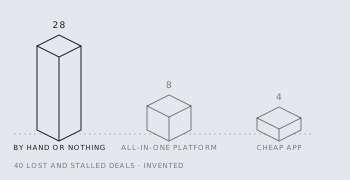
Then the two calls. Say both buyers say each tech loses about one job a week to drive time and a job is worth $400. Thirty techs × one job × $400 × 50 weeks is $600,000 a year. That's the price of the whiteboard, and it's the number Acme's reps lead with. The all-in-one platform is second on the list, and the competitor slide would have put it first.

Competitive Positioning and Go-to-Market: What the Map Decides
Whoever sits in the top row decides your competitive positioning: three things about how you sell, whether you've drawn the map or not.
- What your reps compare you to. If the spreadsheet is row 1, "easier than the big platform" is the wrong comparison. Easier than the whiteboard is the right one.
- What your price gets measured against. Against a free spreadsheet, a monthly fee looks expensive. Against the contractor's $600,000 a year in lost jobs, it doesn't.
- What your marketing efforts have to do first. I'd show a buyer doing nothing what it costs before anything else; until then, I wouldn't expect them to look at anyone, you included. In my experience, most marketing strategies skip that step and jump to why you're better than a rival the buyer isn't considering.
A competitive advantage only counts against something on this map. So draw the map before strategic planning starts. The positioning statement guide shows how the top row and your reason against it become the paragraph your reps say.
When to Redraw Your Competitive Landscape as the Market Shifts
A funding round or a lost client feels like the market landscape changed. Usually it hasn't: the rival with new funding moves up a row, and doing nothing is still at the top. Rerun steps 3 to 6 of the landscape analysis before you change the pitch.
I'd redraw it twice a year from the newest deals, and whenever market conditions shift under you: a change in what a buyer can do by hand, a new kind of tool, a rival's funding round. Between redraws, watch your win rate against each row, doing nothing included.
Competitive Landscape Questions, Answered
What Is a Competitive Map?
A chart that places competitors on two axes, often price and quality, so you can see where they cluster and identify market gaps. It's only useful if the two axes are how customers perceive the choice. Built from your deals, I'd use two: what it costs the buyer to keep their current way, and how hard it is to switch.
What Is a Substitute or Replacement Competitor?
An alternative that solves the buyer's problem without being a product like yours: the spreadsheet, the hire, the consultant, or keeping the status quo and doing nothing. Under $15M, that group usually wins the most deals, and in my experience it gets the least attention.
How Do You Describe a Competitive Environment?
By the alternatives your buyers weigh, how often each one wins, and what each costs the buyer to keep. A description that short fits on one page your reps can carry into a call.
What Is the Difference Between a SWOT Analysis and a Competitive Landscape Analysis?
A SWOT analysis lists your company's strengths and weaknesses, and the opportunities and threats around it. A competitive landscape analysis looks at what your buyers weigh instead of you, ranked by how often each one wins. I'd do the landscape first, so the threats in the SWOT are the ones your buyers actually chose.
What Are Porter's Five Forces?
A textbook way to describe industry structure. The five are rivalry among existing competitors, the threat of new entrants, the threat of substitutes, and the bargaining power of buyers and of suppliers. In my experience, at your size the force that matters most is the substitute, and doing nothing is one.
What Is the Difference Between Primary and Secondary Research in a Competitive Analysis?
Primary research is what you collect first-hand for the question: the calls to your buyers and the questions you ask of each deal. Secondary research is what already exists: rivals' websites, analyst reports, trade press, even your CRM. I'd start with your own deals and the calls, because they're the only sources that show you the buyers who chose to wait.
What Is Market Share in a Competitive Landscape?
Market share is a rival's slice of total sales in your market. Relative market share compares it with the leader's. I'd look at it last: a rival with a big market share can sit in row 3 on your map if your buyers rarely weigh it.
What Is the Difference Between Industry Analysis and Competitive Analysis?
Industry analysis describes the whole industry: its size, its market growth rate, and how hard it is to make money in it. Competitive analysis compares you with the rivals in it. I'd use industry analysis to decide whether to enter a market, and a competitive landscape analysis built from your deals to decide how to win in the one you're in.
What Is Competitive Positioning?
Competitive positioning is where you stand against the alternatives your buyers weigh, and why you win against each. I'd set it against the top row of your competitive landscape, not against the biggest name in your industry.
How Do You Find a Competitive Advantage in Your Competitive Landscape?
Look at the top row and write why you win against it, with proof a buyer can check. In my experience, a competitive advantage that only holds against a rival your buyers don't weigh doesn't close deals. The differentiation guide has the test.
What Is Competitive Intelligence?
Competitive intelligence is the ongoing tracking of rivals: their websites, pricing and launches. Software handles that continuous monitoring well. I'd point it only at the rivals near the top of your map.
Do You Need Market Research for a Competitive Landscape?
Outside market research tells you how big a market is. In my experience it can't tell you what your buyers did instead of buying from you, and neither can industry trends. I'd check market trends against the map once it's drawn, not use them to draw it.
What Competitive Insights Should a Landscape Give You?
Three: who you lose to most, what it costs the buyer to keep, and why you win against it. Those three drive the strategic decisions about your price and your pitch. I'd hold off on new marketing tactics until you have them.
How Does a Competitive Analysis Shape Business Strategy?
It tells you which alternative the strategy has to beat. With the top row priced, you can make informed decisions about price, pitch and where marketing goes first. In my experience, a competitive edge against a rival your buyers don't weigh never shows up in the win rate.
How Do You Analyze Competitors' Strengths and Weaknesses?
Start with your deals. What lost buyers liked about a rival is its strength; what your won buyers say it lacked is its weakness. Their websites tell you what they claim, so I'd read those last.
Who Should Build Your Competitive Landscape
You. You know the deals, and the decision is yours. The cost is reading the losses honestly, including the ones you'd rather blame on price. Most CEOs who call me have tried this and stopped at the hard part.
Competitive intelligence software or a research firm. Good at tracking rivals' websites, pricing and launches. Neither can tell you how many of your buyers chose to wait, because that's only in your deals.
Advisory. $3,000 to $4,000 a month, remote, month to month. I read your lost and stalled deals and tell you what I'd decide: who you're really up against, in what order, and what to say against each. Your team builds it. Nothing reports to me; I answer to you.
Done my way: Fractional CMO. $5,000 to $7,000 a month, remote, month to month, with no minimum term and no notice period. Your marketing team reports to me and I report to you. I read the deals and make the calls to buyers myself, rank the alternatives with you, and build the messaging and prospecting against the top row, in that order, so the position gets used instead of filed.
Price Doing Nothing Before You Change the Pitch
Pull the lost and stalled deals this week and write one line on each: what the buyer did instead. Then make the two calls and put a number on the top row. Once it has a price, the differentiation guide shows how to find your competitive advantage against it.
Until your reps can say what doing nothing costs the buyer, in his numbers, in my experience much of your lead budget goes to beating a rival he isn't considering.
- 2020Fractional CMO & CROAveraged across clients2–6× · pipeline
- 2018Chief Revenue Officer20-year-old company+300% · 2 years
- 2015VP of Sales & MarketingStartup+107% · 2 years
- 2014EVP Sales & MarketingStartup → Unicorn Status+300% · 1 year
- 2006VP Channel & Business DevelopmentStartup → Unicorn Status+600% · 8 years
- 1999Global Sales DirectorPublic Software Company+400% · 7 years
Free: a week of analysis, a one-hour report-out, and an action plan you keep.