Ideal Customer Profile: Find More Customers Like the Ones Who Already Pay You
How to build an ideal customer profile from your deals: what your best wins share that your losses don't, a template, a worked example and the disqualifiers.

An ideal customer profile (ICP) describes the companies you should be selling to first. In my experience, most are written from the customer you'd like to have. Build yours from the deals you've already won, lost and stalled, and it tells you exactly who to look for: more of the customers you already love.
"We thought we knew what we were doing, our customers love us, but we can't seem to get enough of them." That's how a lot of the CEOs who call me start. In my experience, the answer to the second half is in the first: the customers who love you are telling you who you're for. Usually nobody has written it down.
Who you're for is the first of the three decisions in market positioning. I'd settle it first, because every marketing campaign, every list and every rep's quarter after it is aimed at the company it names. Name the wrong one, and all three are aimed at the wrong company.
CEOs also tell me, "We need leads. And in order to have leads, we need marketing. What we're doing isn't working." When I hear both, I look at who the marketing is aimed at before I look at the marketing.
What Is an Ideal Customer Profile (ICP)?
An ideal customer profile describes the companies most likely to buy from you and get the most from it: the industry, company size, number of employees, revenue, location and tech stack. Your marketing and sales teams use it to decide which target accounts to chase and which leads to turn down.
Most guides build it from firmographic data and demographic data. Firmographics tell you where to look, not why a company bought.
I'd define an ideal customer profile by what's true of your best customers that isn't true of the deals you lost. Company size and industry are where you look. What they were fixing, and what nearly stopped them, tells you why they bought.
Ideal Customer Profile vs. Buyer Persona vs. Target Market
- Target market: the whole set of companies you could sell to.
- Ideal customer profile: the companies in that market you should be selling to first, described by account.
- Buyer persona: the person inside those companies who signs, and the people around them, described by role.
I'd write the ideal customer profile first. A buyer persona written before it can describe someone at a company you shouldn't be selling to.
Why Ideal Customer Profiles Describe the Customer You'd Like
In my experience, an ICP goes wrong four ways, and each one lets in leads your sales team should turn down.
It starts from the logo you'd like on the website. It gets written in a planning meeting, aimed at the bigger account the team wants.
It's built from the wins only. A pattern in the wins only means something if it's missing from the losses.
It leaves out the stalls. In the pipelines I've read, the deals that went quiet and never decided are often the biggest group, and in my experience the one an ICP leaves out.
It's too broad to say no to. "B2B companies with 50 to 500 employees" fits so much of the target market it can't turn anyone down. If your ICP can't turn down a lead, it isn't doing the job.
How to Create an Ideal Customer Profile From Your Deals
Step 1: Pull two years of deals. The ones you won, the ones you lost, and the ones that stalled and never decided. I'd start with the customer data in your CRM and ask the reps for what it's missing. Include existing customers who bought before you had a CRM.
Step 2: Ask four questions of each deal. Who bought, what were they fixing, how long did it take, and what nearly killed it. Write one line per answer.
Step 3: Mark the wins you'd want ten more of. The ones that closed without a fight, paid on time, stayed, and sent you the next one.
Step 4: Find the pattern in those wins that's missing from the losses. That's who you're for. Look past company size and industry to the situation: what had just happened to them, and what they'd already tried. It'll be narrower than you'd like. A profile describes the pattern, not a perfect customer. If no pattern shows up, don't force one. Write the profile wide, mark it "draft," and reread it after the next twenty deals.
Step 5: Read the stalls against the pattern. A stall that fits the pattern is a buyer who chose to do nothing, and the competitive landscape guide shows what to do about it. A stall that doesn't fit is a lead you should have turned down.
Step 6: Write the disqualifiers. The things that were true of the losses and never true of your best wins. They're the part of an ICP your sales team will use most.
Step 7: Check it's big enough. Count the target companies that fit. If winning your usual share of them doesn't reach this year's number, widen the profile one field at a time, starting with the one that matters least.
Ideal Customer Profile (ICP) Template
Here's the ideal customer profile template I'd use. Each field says where its answer comes from.
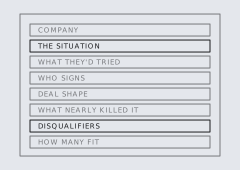
The company, who-signs and deal-shape rows come out of a CRM export. The situation and disqualifier rows take longer, and the disqualifiers are the row I'd expect your reps to use most.
Ideal Customer Profile Example
The company is invented to show the method; it's not a client. Say Acme sells field service scheduling software, and reads 60 deals from the last two years: 20 won, 16 lost, 24 stalled.
Of the 12 wins Acme would want ten more of, 9 started within a month of a dispatcher quitting or the owner adding a location. Two of the 16 losses did, and three of the 24 stalls. That's the situation row, read out of the deals. The three stalls that fit are buyers who chose to wait; the other 21 were leads Acme should have turned down.

That's narrower than "home services companies," and Acme's reps can turn down a lead with it on the first call.
Then the size check. Say Acme needs 48 new customers this year: at about $40,000 a year each, that's $1.92 million. Forty-eight is 2% of the 2,400 that fit, and Acme wins about ten a year now. So either the profile widens one field, starting with the one that matters least, or the way Acme sells to it has to change. The profile alone won't close that gap.
The Customers You Like Who Don't Fit
Every company I've worked for had a few customers it liked who weren't in the pattern. Three kinds I've seen: a friend of the founder's, an early account that bought before the product was ready, a big name that took two years to close.
Your ideal customer profile doesn't fire them. It stops your marketing efforts from looking for more of them. Keep serving them; just don't build the next marketing campaign around them.
What a Written ICP Lets You Stop Doing
- Approving every lead yourself. A rep with a written disqualifier can turn down a bad-fit lead without asking you first.
- Refereeing marketing and sales. Score leads against the profile and the disqualifiers, and you can check whether sales accepts what marketing sends, because your sales and marketing efforts are aimed at the same companies. Conversion rates follow the fit, not the volume.
- Guessing what the next campaign says. The situation row is where the message starts, and the positioning statement guide shows how it becomes the paragraph your reps say. The "what nearly killed it" row is the objection they prepare for, and the differentiation guide tests the reasons they answer it with.
Ideal Customer Profile Questions, Answered
What Does ICP Stand For in Marketing?
ICP stands for ideal customer profile: the description of the companies you should sell to first. In B2B it's an account-level description; the buyer persona describes the people inside the account.
Is an Ideal Client Profile Different From an Ideal Customer Profile?
No. Ideal client profile is the same thing in a services firm's words. The method is the same: read the engagements you won, lost and stalled, and find what's true of your best clients that isn't true of the rest.
Can You Have More Than One Ideal Customer Profile?
Yes, if you sell different things to different companies, or the same thing for different reasons. I'd start with one, though. In my experience, a company your size that thinks it has three usually has one that buys and two it would like to.
What Is a Negative ICP?
The written list of companies you shouldn't sell to: the disqualifiers row, made into its own page. I'd keep it in the same document, because the reps use it on the same call.
How Often Should You Update Your Ideal Customer Profile?
I'd reread it against the newest deals twice a year, and whenever the pattern in your wins changes: a new product, a new market, a new kind of company closing faster than the rest. A year on, look at which new customers remain loyal. If the ones at the edges of the range left, narrow it.
What Are the Key Components of an Ideal Customer Profile?
Start with firmographic data: industry, company size, number of employees, revenue and location. Add the tech stack, who signs and the deal shape. I'd add the situation, meaning the pain points that made them start looking, and the disqualifiers. Those two are the key characteristics a CRM export won't give you.
What Data Do You Need to Build an Ideal Customer Profile?
Four data points per deal: who bought, what they were fixing, how long it took and what nearly killed it. Gather data from the CRM first, then ask the reps for what it's missing. I'd want accurate data on the losses and stalls as much as on the wins, because a pattern only means something if it's missing from them.
Do You Need Market Research to Build an ICP?
Not to start. I'd treat your own deals as the market research that counts, because they show who actually paid. Outside research helps later, when you count how many companies fit.
How Is an ICP Different From a Target Audience?
Target audience is the marketing word for the people your campaigns are meant to reach. The ICP names the companies they work at, and the buyer persona names the people inside them. I'd write the ICP first, so the target audience is drawn from it.
How Does an Ideal Customer Profile Help Lead Generation?
It tells lead generation which companies to go after and which to skip. I'd judge it by how many leads sales accepts, not how many come in.
How Does an ICP Fit Into the Sales Process?
It decides which companies enter the sales process at all. The disqualifiers end a bad-fit deal on the first call, and the "what nearly killed it" row is the objection your reps prepare for.
How Do You Create Content for Your Ideal Customers?
Start from the situation row: what had just happened to them, and what they'd already tried. I'd create content about that, in the words your best customers used when they bought.
Who Should Build Your Ideal Customer Profile
You. The profile is a company decision, so it's yours. The cost is reading every deal yourself, including the losses. Most CEOs who call me have tried this and stopped at the hard part.
A data or intent tool. Good at finding more companies that match the firmographics once you know them. It can't tell you which situation made your best customers buy, because that's in your deals.
Advisory. $3,000 to $4,000 a month, remote, month to month. I read your won, lost and stalled deals and tell you who I'd decide you're for, and what to turn down. Your team writes it up and uses it. Nothing reports to me; I answer to you.
Done my way: Fractional CMO. $5,000 to $7,000 a month, remote, month to month, with no minimum term and no notice period. Your marketing team reports to me and I report to you. I read the deals and talk to the customers myself, write the profile with you, and then aim the messaging and the prospecting at it, so marketing has one owner who answers to you.
Find the Wins You'd Want Ten More Of, Then Go Get More of Them
Pull two years of deals this week and mark the wins you'd want ten more of. Then look for what's true of them that isn't true of the losses.
What you find is the version your buyers have already agreed to, by paying. Once it's written, the next question is what those buyers do instead of buying from you; the competitive landscape guide starts there. At your size the most common answer is nothing.
- 2020Fractional CMO & CROAveraged across clients2–6× · pipeline
- 2018Chief Revenue Officer20-year-old company+300% · 2 years
- 2015VP of Sales & MarketingStartup+107% · 2 years
- 2014EVP Sales & MarketingStartup → Unicorn Status+300% · 1 year
- 2006VP Channel & Business DevelopmentStartup → Unicorn Status+600% · 8 years
- 1999Global Sales DirectorPublic Software Company+400% · 7 years
Free: a week of analysis, a one-hour report-out, and an action plan you keep.