Positioning Statement: Write One From Your Deals That Your Sales Team Can Say Out Loud
How to write a positioning statement from your won, lost and stalled deals, with a template, examples, and the two tests it has to pass before anyone prints it.

A positioning statement is one paragraph: who you're for, what they'd do instead, and why you win. In my experience, most get filled in before anyone reads a deal, so they describe the company you hope you are. Below is how to write your own positioning statement from the deals, and the two tests it has to pass before anyone prints it: a rep can say it without reading it, and a buyer's push-back doesn't break it.
You may already have one. It's in the last agency's brand deck, or the notes from an offsite, or the About page. Ask three reps to say it without looking. Three answers means your market positioning is still open, and I wouldn't expect better wording to close it.
CEOs tell me, "I know we're paying for marketing. I don't know how much, but I know we're spending a lot and not getting anything in return for it." Three reps with three answers is where I'd look first for where it goes.
I've written every sales deck for every company I've worked with since 1999. Your sales deck is a positioning statement with slides, and when the paragraph underneath is wrong, so is every slide.
What Is a Positioning Statement?
A positioning statement is one internal paragraph: who your product or service is for, what that target customer would do without you, the market category they'd file you under, and why they pick you, with the proof. Your marketing and sales teams use it to point every message the same way. Customers never see it.
Most guides list four key components: the target market, the frame of reference (your market category), the point of difference, and a reason to believe.
I'd define it by who has to use it. A good positioning statement is one a rep can say on a call without reading it, and one that still stands when a buyer pushes back.
Positioning Statement vs. Value Proposition vs. Mission Statement vs. Brand Promise
- Mission statement: why the company exists. Public, and about the company.
- Value proposition, unique value proposition or unique selling proposition: one line of messaging, the benefit a buyer gets that the alternatives can't offer. It's built from the positioning statement's last two lines.
- Positioning statement: the decision underneath both. An internal tool, and about the buyer.
- Brand promise or tagline: the public line, written from the statement.
A brand positioning statement is the same paragraph under another name: under $15M, brand positioning and market positioning are one decision. If you only have time for one, write this one. The value proposition, the website and the deck are all written from it, so I'd write it before any of them.
Why Brand Positioning Statements Don't Get Used
In my experience, a positioning statement at a company your size fails in one of four ways, and all four are settled before a rep ever says it.
- It was filled in before the deals were read. So it says what you hope is true, not what your buyers already told you.
- It names a competitor instead of the alternative. "Unlike the big competitor" reads well in a workshop. Your buyer's real alternative is often the spreadsheet, the intern, or doing nothing at all.
- Its reason is "great service." Or "award-winning support," or "innovative." None of them survives a buyer saying "so does everyone else."
- It was written to be framed. Long sentences, core values, words no rep uses on a call. If a rep can't say it, the buyer never hears it.
You'll read advice not to write a positioning statement at all, because the template assumes you already know the answers. That's true of the template. Your team still needs one paragraph to say, and somebody has to write it from the deals.

The Positioning Statement Template (Fill In the Category Last)
Here's the positioning statement template I'd use:
For [your target audience, described by what they're trying to fix],
who today [what they'd do if you didn't exist, doing nothing included],
[your company] is the [market category the buyer would file you under]
that [the reason you win, in words a buyer can check],
because [the proof: a number you can show, a list a buyer can read, a customer who'll take the call].
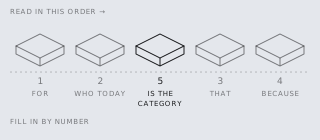
Fill it top to bottom and you pick the category before you've found the reason. I'd fill it in this order instead, and the steps below follow it: who it's for, what they do today, why you win, the proof, and the category last.
Picked before the reason, I'd expect the category to be the one you'd like to be in. Written last, I'd expect it to be the one your buyer already uses to compare you, which is the one that makes your reason easiest to see.
How to Write an Effective Positioning Statement From Your Deals, Step by Step
Step 1: Pull two years of deals. Won, lost, and the ones that stalled and never decided. For each, write down who bought, what they were fixing, how long it took and what nearly killed it.
Step 2: Write the "for" line (your target audience). Look at the wins you'd want ten more of. The pattern in them that's missing from the losses is who you're for. It'll be narrower than you'd like. The ideal customer profile guide has the method.
Step 3: Write the "who today" line. Ask a few of those best customers what they'd have done if you didn't exist, then add what the lost and stalled deals in the pattern did instead. Rank the answers. The top one goes in this line, and at your size it's often nothing. The competitive landscape guide ranks them.
Step 4: Write the "that" line (your unique value). Ask two of your best customers why they picked you over what they'd otherwise have done. Keep the reasons that come up twice.
Step 5: Write the "because" line. Every reason gets a number you can show, a list a buyer can read, or a customer who'll take the call. A reason you can't prove goes in the bin, however true it feels.
Step 6: Pick the category. Choose the one your target customer would file you under when comparing you to the "who today" line. If you have to explain why you're unlike everything else in it, I'd take that as the wrong category.
Step 7: Run the push-back test. Read the "that" and "because" lines to someone playing the buyer, and have them say "so does everyone else." If the "because" line answers, it stands. If not, go back to step 4. The differentiation guide runs this test in full.
Step 8: Hand it to a rep. Give it to the rep who closes the most and ask them to say it back. If the rep rewrites it to say it, keep the rep's version.
Brand Positioning Statement Examples
The first two companies below are invented to show the form; neither is a client.
The inside-out version (the one to avoid):
For growing businesses, Acme is the innovative, best-in-class field service platform that delivers award-winning support and unmatched value.
Every word could sit on any competitor's site. There's no buyer in it, no alternative, and nothing a buyer could check.
A strong positioning statement for the same company, written from the deals (the 40 lost and stalled deals are in the competitive landscape guide):
For owners of regional HVAC contractors running 30 to 120 technicians, who today dispatch from a whiteboard and a spreadsheet, Acme is the field service scheduling software that books the next job before the tech leaves the last one, because it reads the route, the parts on the truck and the warranty on one screen, and a dispatcher can watch it book a job in the demo.
Now a rep knows who to call, what to compare against, and what to show on the first demo.
A services firm:
For finance teams at companies of 200 to 2,000 people moving their books off spreadsheets, who'd otherwise hire a large implementer or keep closing by hand, Ledgerline is the ERP implementation firm that goes live in forty-five days, because we don't customize, and here are the last ten.
Mine, written the same way:
For B2B CEOs whose growth has stalled somewhere between $1M and $15M, who'd otherwise promote someone junior into marketing, keep running it themselves, or spend months searching for a full-time CMO, I'm the fractional CMO who fixes revenue in a fixed order: positioning, messaging, prospecting, sales. Because I've worked in that order in every revenue role since 1999, and revenue grew in every leadership role I've held, somewhere between 107% and 600%.
That last line is my record, not a forecast of yours. I don't guarantee outcomes.
Run it through step 7 against the three alternatives it names. In my experience, someone junior promoted into marketing is running it for the first time. I've run marketing and sales in every revenue role I've held since 1999. Running it yourself means doing it on top of the job you already have. And a full-time CMO search takes three to six months before anyone starts.
Why Famous Brand Positioning Statements Are the Wrong Model at Your Size
In my experience, a consumer brand with a national ad budget can hold a position with feeling. You hold yours with a reason a prospective customer can check, said by a rep who believes it.
How to Tell Your Brand Positioning Statement Is Working
Once it's printed, I'd look for five things.
- Reps say it without reading it, each in their own words, and it's still the same paragraph.
- The six answers match. Ask three people inside (one who never talks to a customer) and three customers what you do for them; if the six answers aren't one answer, positioning is open. The six-answers check is in the market positioning guide.
- It survives the push-back. When a buyer says "so does everyone else," the "because" line answers.
- Sales takes the leads marketing sends, because marketing efforts and sales calls are aimed at the same "for" line.
- Your win rate against the "who today" alternative holds or rises.
If the statement changes every time someone joins marketing, it isn't a positioning statement yet. It's a draft.
Positioning Statement Questions, Answered
Who Should Own the Positioning Statement, Marketing or the CEO?
Under $15M, I'd have the CEO own it. It decides who the company is for, which is a company decision, and marketing and sales both have to live with it. Marketing can draft it; the CEO signs it.
Positioning Statement vs. Elevator Pitch: What's the Difference?
The positioning statement is internal, and its last two lines are built to be checked. The elevator pitch is what a rep says out loud, built from it. If you can't get a pitch out of the statement in one breath, I'd cut the statement.
How Long Should a Positioning Statement Be?
One paragraph, two to four sentences. If it takes longer to say than a rep has on a first call, cut it until it doesn't.
What Are the Three C's of Brand Positioning?
The usual three are the company, the customer and the competition. I'd read the third as the competitive set your buyers actually weigh, doing nothing included.
Do Small Businesses Need a Positioning Statement?
I'd say they need it more. In my experience, a small business can't afford to say five things and see which one works. One paragraph, written from the deals, is what I'd give a team of three and a team of thirty alike.
What Makes a Good Positioning Statement?
A good positioning statement names a buyer a rep could find, the alternative they'd otherwise choose, and a reason they can check. A well-crafted positioning statement that fails the push-back test is still a draft. I'd call it a strong positioning statement only once it passes step 7: someone playing the buyer says "so does everyone else," and the "because" line answers.
Is a Positioning Statement the Same as a Brand Promise?
No. The brand promise is public. It's the line potential customers see. The positioning statement is internal, and the brand promise is written from it.
Where Does a Positioning Statement Fit in Your Marketing Strategy?
It comes first, because your marketing strategy is built on it. I'd aim the website, the campaigns and the content marketing at whoever the "for" line names. Get that line wrong and every piece is aimed at the wrong buyer.
What Should a Positioning Statement Say About Customer Pain Points?
The "for" line names the problem your target customer is trying to fix, in their words. I'd take the customer pain points from the deals you won, not from a workshop. A pain point no buyer mentioned doesn't belong in it.
How Is a Positioning Statement Different From Brand Identity?
Brand identity is how you look and sound: the name, the logo, the colors, the voice. I'd decide the positioning statement first, and let the brand identity carry it.
Can Market Research Replace Reading Your Deals?
Outside market research can describe a market. In my experience it can't tell you why your buyers picked you over doing nothing; that's in your deals. I'd read the deals first and use outside research to check the size of the target market.
How Do You Maintain Consistency in Your Brand Messaging?
Write the value proposition and every other message from the statement, and check each one against the "that" and "because" lines. I'd reread the statement twice a year and run the six-answers check above. If the six answers aren't one answer, positioning is open.
Who Should Write Your Positioning Statement
You. It's your decision anyway. The cost is the hours to read the deals and the honesty to retire the "great service" line. Most CEOs who call me have tried this and stopped at the hard part.
A brand or positioning agency. A workshop, a deck, and a statement written from the inside: your team in a room, your opinions on sticky notes. In my experience, a position written without the deals read doesn't get used.
Advisory. $3,000 to $4,000 a month, remote, month to month. I read your deals and tell you what I'd decide: who you're for, what you're up against, why you win. You make the call, and your team writes the paragraph. Nothing reports to me; I answer to you.
Done my way: Fractional CMO. $5,000 to $7,000 a month, remote, month to month, with no minimum term and no notice period. Your marketing team reports to me and I report to you.
I read the won, lost and stalled deals and talk to the customers myself, make the three decisions with you, write the statement with you, and then build the messaging and the prospecting on top of it, in that order, so the position gets used instead of filed.
Say It Out Loud Before You Print It
Write your positioning statement after you've read the deals, then hand it to the rep who closes the most and ask them to say it to you.
If it sounds like your website, start over. If it sounds like your best customer explaining why they bought, it's done. Messaging, the second of the four fixes in the RevenueEngine™, is built from it, and so is every slide.
- 2020Fractional CMO & CROAveraged across clients2–6× · pipeline
- 2018Chief Revenue Officer20-year-old company+300% · 2 years
- 2015VP of Sales & MarketingStartup+107% · 2 years
- 2014EVP Sales & MarketingStartup → Unicorn Status+300% · 1 year
- 2006VP Channel & Business DevelopmentStartup → Unicorn Status+600% · 8 years
- 1999Global Sales DirectorPublic Software Company+400% · 7 years
Free: a week of analysis, a one-hour report-out, and an action plan you keep.